
Check San Francisco Voter Registration
California My Voter Status is the first stop for a San Francisco voter checking a personal voter registration record. The form is a private self-lookup, not a way to browse other residents. Enter the identifying details tied to the registration, submit the form, and review the returned status. A match may confirm party preference, language preference, polling place and election information, and vote-by-mail or provisional-ballot status. If the entry is missing or out of date, use the San Francisco Department of Elections tools rather than trying name variants in a public directory.
The live form uses personal matching fields. Some inputs may be conditional based on the route the tool presents, and sensitive identity numbers are used only for verification. They are not exposed as public voter data.
| Lookup label | Input | Need | How it is used |
|---|---|---|---|
| First Name | Text | Required | Voter's first name |
| Last Name | Text | Required | Voter's last name |
| Date of Birth | Date | Required | Matches the personal registration |
| California driver license, ID, or SSN fragment | Text | Conditional | Identity check; full numbers are not public |
| County or residence ZIP | Choice or text | Conditional | Routes the lookup by residence |
| Submit or Search | Button | Not applicable | Runs the status check |
The official My Voter Status form is shown here with the fields used to confirm a personal record.
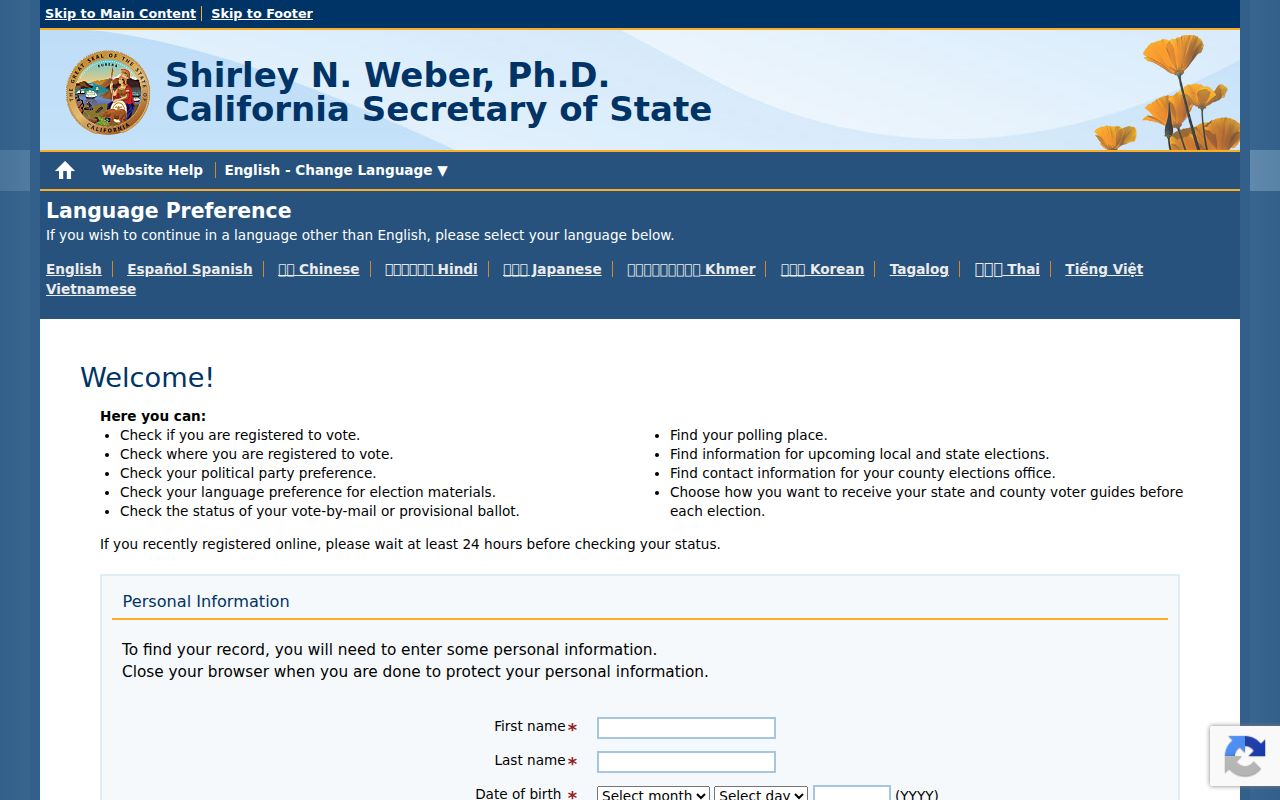
The screen reinforces the key boundary: a voter supplies private matching details before the system returns status information.
San Francisco Voter Lookup Boundaries
California voter records are not an open people-search directory. That distinction matters in San Francisco because the same subject has two tools that serve different users. My Voter Status lets a person check their own record. A voter file request serves approved election, scholarly, journalistic, political, or governmental purposes. Knowing a name or address alone does not create a right to browse the roll.
The San Francisco Department of Elections portal offers local voter tools for registration, ballots, polling places, and election administration. It is the right fallback when the state self-lookup does not resolve a current San Francisco issue. Broader questions about agency records and the California Public Records Act belong with the general San Francisco public records access process, but that law does not erase the specific voter-file limits.
Note: A personal status check and a regulated voter-file request are separate channels with different identity, purpose, and disclosure rules.
Fields in San Francisco Voter Records
An approved California voter file can carry useful civic facts. It may show a registrant's name, residence and mailing addresses where allowed, party preference, status, registration date, precinct, and voting districts. Participation history can indicate whether the person voted in a named election. It never shows how anyone marked a ballot. No Party Preference is also a valid party-preference entry in California.
| Name | Available in the regulated file for an approved purpose |
|---|---|
| Residence address | Available to authorized users except for confidential voters |
| Mailing address | Available where allowed; withheld for protected records |
| Party preference | May show a qualified party or No Party Preference |
| Status and date | May show active, inactive, or cancelled status and registration date |
| Precinct and districts | Places the voter within local civic geography |
| Vote history | Participation only, never a ballot choice |
| DOB, ID, SSN, signature | Restricted or confidential, not public browsing fields |
Confidential under California law. Elections Code sections 2188 and 2194 and the related access regulations withhold driver's license or state ID numbers, Social Security number fragments, signatures, unique voter IDs, and confidential-voter information from requesters.
This public and confidential split keeps the usable file focused on election administration and civic study. It also protects the most sensitive identity data from becoming a public search result.
How San Francisco Voter Rolls Change
VoteCal is California's centralized registration database. San Francisco elections officials continuously send active and inactive voter information into the statewide system. That shared process supports new voter registration entries, address and party updates, inactive status, cancellations, and other list-maintenance work governed by state rules and federal election law.
Status is administrative, not a judgment about a person. An inactive entry may reflect the list-maintenance process, while a cancelled entry no longer functions as a current registration. A person who moved, changed a name, or sees an unexpected status should return to the self-lookup and then contact the local elections office. Registration updates belong in the official system, not in a third-party list.
Protected San Francisco Voter Records
Some voter records receive more protection than the ordinary regulated file. California's Safe at Home program provides a substitute mailing address to qualifying participants, including survivors of stalking, domestic violence, sexual assault, human trafficking, and other categories defined by the program. The protection can affect the address trail that appears in election and other public-facing records.
Separate Elections Code provisions also cover qualifying confidential voters and protected public officials, including sections 2166, 2166.5, 2166.7, and 2166.9. Their protected address or contact data does not become available merely because another requester has an otherwise approved purpose. A blank or withheld field can be a required privacy measure, not a database error.
Note: Protected voter information stays confidential across the request process, so never infer a current address from an older registration source.
Request San Francisco Voter Files
The Secretary of State voter-file request page sets out the state route. Applicants identify themselves and any organization, provide contact details, choose and explain a permitted purpose, define the geographic or data scope, certify lawful use, complete identity verification, and pay the applicable charge. State materials list $100 for a statewide voter-file application. Requests for specific voter records are $30 per record, capped at $100 for up to ten records. Review usually takes 7 to 14 business days.
| Request item | What California requires | Practical check |
|---|---|---|
| Applicant | Name, organization, and contact information | Use details that match the submitted identification |
| Purpose | Election, scholarly, journalistic, political, or governmental use | Give a detailed explanation |
| Election details | Candidate, committee, measure, or election facts when relevant | Complete when the purpose depends on them |
| Data scope | Statewide or named jurisdiction and requested data | Specify San Francisco County when appropriate |
| Certification | Signed agreement to follow access and use rules | Read the limits before signing |
| Identity and payment | Verification and the applicable fee | Follow the stated submission method |
The official California voter-file request instructions appear in this captured page, including the application route and access limits.
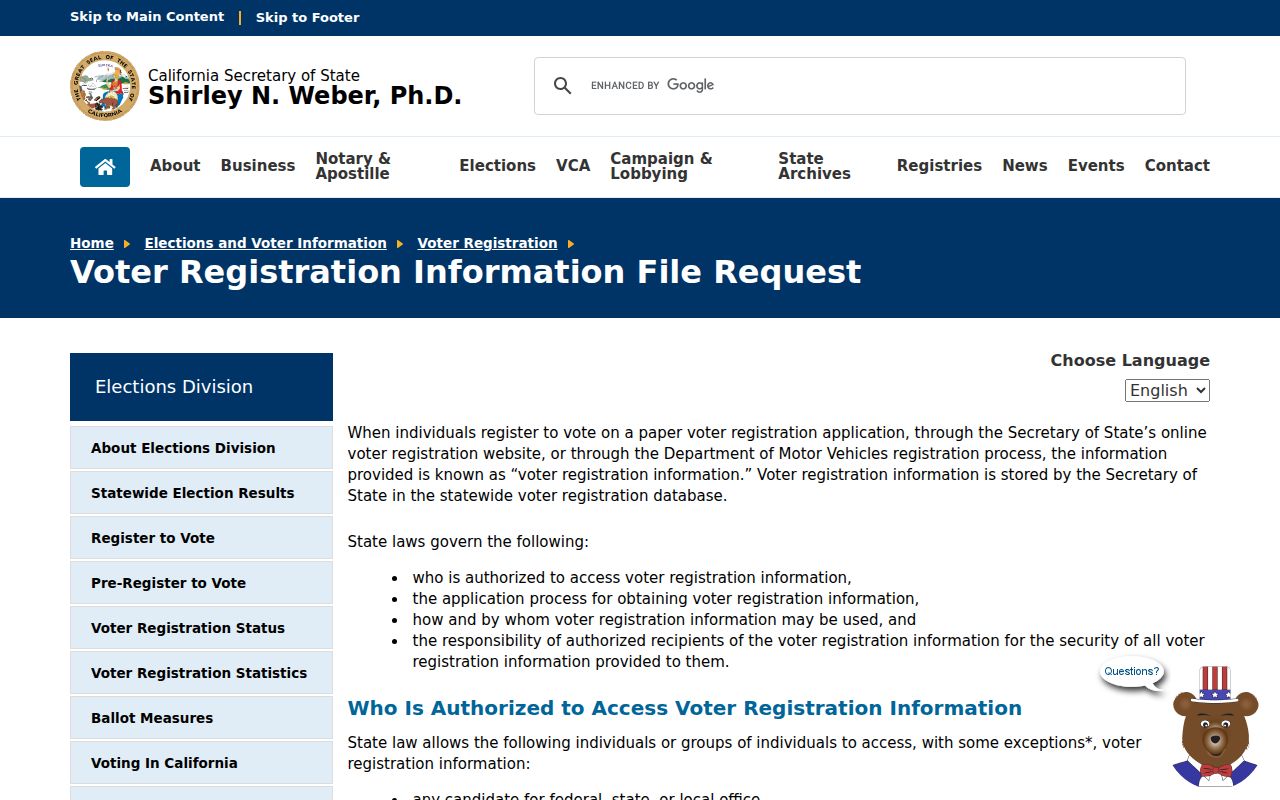
The request page makes clear that approval depends on both the applicant's purpose and agreement to the governing restrictions.
San Francisco Voter Data Limits
Access does not grant free reuse. Elections Code sections 2188 and 2194, Elections Code section 18109(b), Government Code section 7924.000, and Title 2 California Code of Regulations sections 19001 through 19004 form the core access framework cited in state materials. The applicant's stated purpose controls what may be obtained and how it may be used.
Using voter data outside an allowed purpose can lead to penalties. Stalking, harassment, identity theft, and attempts to expose a protected voter may also trigger other civil or criminal rules. Keep the data within the approved project, secure it from unrelated access, and do not republish sensitive address trails. Current disputes over government requests for California voter data underscore the same nonpartisan point: even official requests do not turn the full database into unrestricted public material.
Lawful use is mandatory. A voter-file approval is purpose-specific. It does not authorize public posting, personal targeting, harassment, or any use outside the certified category.
San Francisco Voter Access Channels
The online routes divide by need. Use My Voter Status for a private personal check. Use the Department of Elections portal for San Francisco voter tools, ballot and polling-place matters, local election data, and direct help. Use the Secretary of State request page and voter-file application for regulated data access. The application supplies the written procedure when an ordinary lookup cannot provide the requested file.
For a county-level file, begin with the state rules and application, then ask the San Francisco Department of Elections whether the requested scope is available locally, what fee and delivery format apply, and whether the office handles the request or refers it to the state process. This contact step matters because the research does not document a separate public county file download. Election results and local election data remain available through the elections department, but they are not substitutes for individual records.
Historical San Francisco Voter Records
Current database rules are not the only path for historical research. Old registers, great registers, poll books, voter pamphlets, and election materials may survive in the San Francisco History Center, San Francisco Public Library, the California State Archives, FamilySearch, or other archival collections. SFPL holds local voter pamphlets and propositions, while its long runs of city and reverse directories can fill name-and-address gaps when a voter register is absent.
The 1906 earthquake and fire disrupted many San Francisco record series, so a missing historical entry does not prove that no registration or residence existed. Search neighboring years, variant spellings, city directories, newspapers, reconstructed sources, and archival election material. The History Center also serves as the archives for the City and County, which makes it the best local starting point when old Department of Elections material is no longer held by the current office.
Note: Historical poll books document an earlier record system; they should not be treated as proof of a person's current registration or address.