
San Francisco Public Records Map
San Francisco public records are arranged by custodian, not by one central subject index. The consolidated city-county structure keeps local offices in one jurisdiction, but each department runs a separate system. Start with the record set, then use its index or request channel.
| Record Set | Record Keeper | Web Coverage | Access Route |
|---|---|---|---|
| Deeds, liens, maps | Assessor-Recorder | 1990 to present | Free viewing; online copies; older items at Room 190 |
| Property and permits | Assessor-Recorder, Planning, DBI | Current and historic layers; permits noted from the 1980s | Address, block/lot, permit, or complaint search |
| Civil, family, probate, small claims | Superior Court | Listed case types from 1987 | Case query, mail, or Room 103 file review |
| Criminal court | Superior Court | Separate query and weekly index | Hall of Justice request for full records |
| Birth, death, marriage | County Clerk, DPH, Assessor-Recorder, CDPH | No general person-name portal | Application under copy eligibility rules |
| Current jail custody | San Francisco Sheriff | Current local custody | Name-prefix lookup |
| Fictitious business names | County Clerk | Current and active historical filings | FBN name, file, registrant, entity, or date search |
| Professional licenses | California DCA and boards | Current and historical status varies by board | License status and discipline lookup |
California law does not make every file open. Sealed cases, adoption files, protected addresses, confidential voter data, and sensitive police material may be withheld or redacted. An index entry does not promise the full image is online.
San Francisco Recorder Access
The Assessor-Recorder's Records Manager covers recorded documents from 1990 to the present. Search and viewing are free, and official copies can be bought for instant download. Records created before January 1, 1990 are not in that online collection. They require a visit to the computer kiosks in City Hall Room 190, where viewing is free and staff can help locate an official record.
The recorded-document copy instructions show that split clearly.
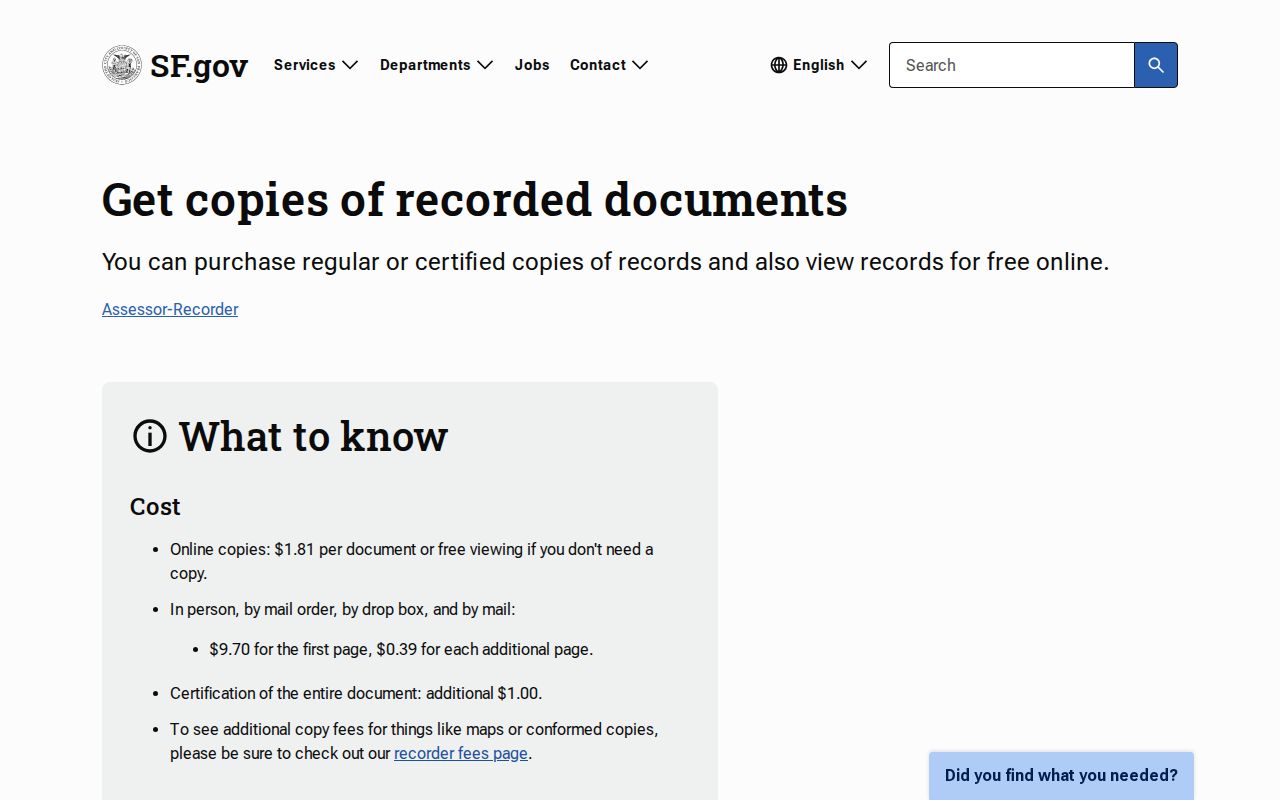
The source page separates the modern online path from the pre-1990 counter fallback, so the date of recording determines the first access channel. Online copies are not certified copies. Ask the Assessor-Recorder for certification when an official certified document is required.
Note: A pre-1990 deed search belongs at Room 190 or in historical collections, not in repeated Records Manager queries.
San Francisco Recorder Search Fields
The Records Manager public index is strongest when a person's name is known. Grantor means a party giving or transferring an interest; grantee means a party receiving it. Names can lead to deeds, trust documents, liens, releases, affidavits, restrictions, and other recorded instruments. Search variants may include a middle initial, former surname, trust name, or business entity.
| Field | Input | Required | How It Narrows the Index |
|---|---|---|---|
| Document Type | Dropdown | No | Limits results to a category of recorded instrument |
| Officials | Text and dropdown area | No | Searches an official capacity or name |
| Grantor/Grantee Name | Text | No | Finds named parties to the document |
| Grantor or Grantee Titles | Dropdown | No | Filters party roles; all types is the default |
| Document Date Range | Date pair | No | Sets beginning and ending dates |
| Document Number | Text or range | No | Finds a known recording number |
| Old Document Number | Text or range | No | Uses a legacy number |
| Block Lot | Text | No | Links the search to San Francisco's parcel identifier |
| Search | Button | Not applicable | Runs the query |
| Clear All | Button | Not applicable | Resets the form |
A result may show document type, parties, date, document number, block/lot reference, and copy controls. The index describes the filing. The image contains the recorded text, subject to access limits.
San Francisco Property Records Channels
Property access begins with the identifier in hand. The Planning Department's Property Information Map accepts an address, block/lot, planning application number, or map click. It can display an assessor summary, zoning, historic data, permits, complaints, appeals, and map layers. The Assessor Community Portal shows assessment history and property characteristics, while Records Manager supplies the recorded chain.
The Accela property lookup shows another official route into address, parcel, record, and licensed-professional data.
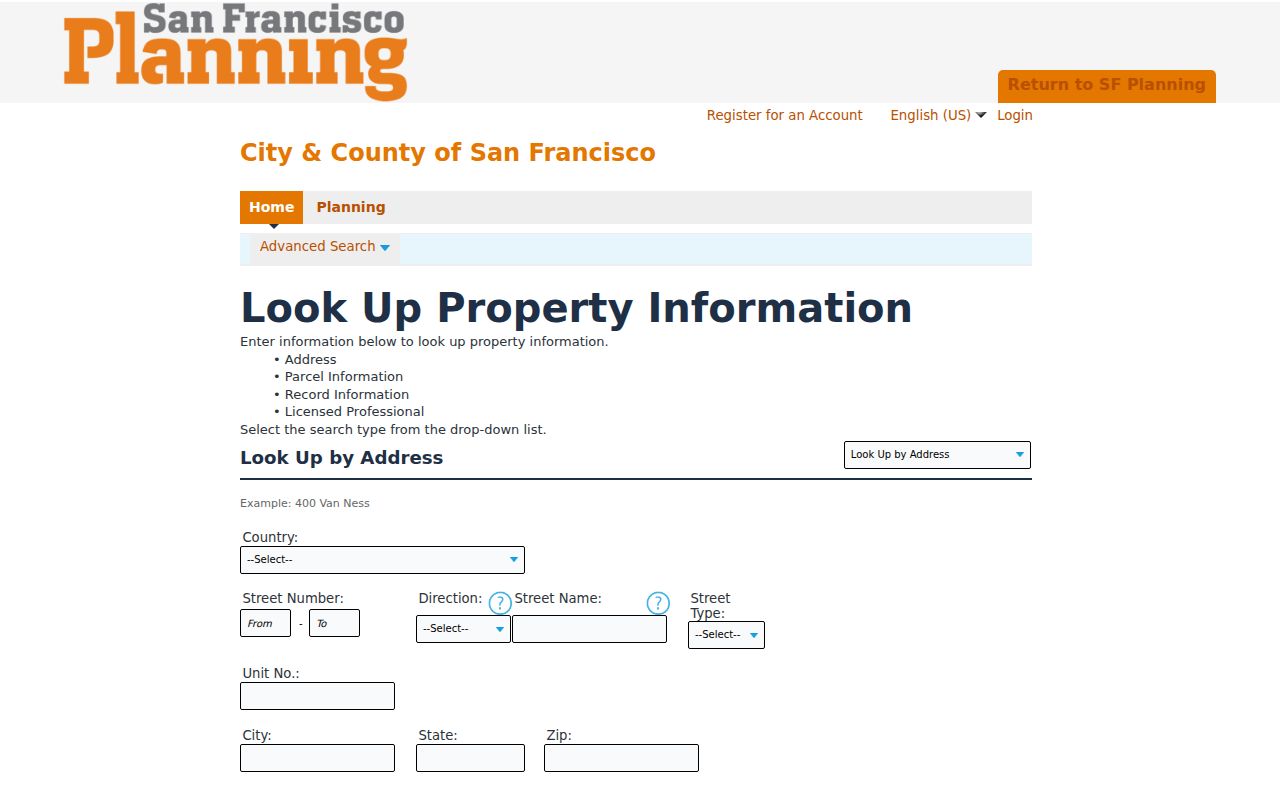
That screen is useful when a planning or permit record, rather than a deed, is the target. The Property Information Map is broader for address context, and the Assessor real-property search accepts an address or APN/block-lot. Owner-name browsing is not the main assessor web mode, so name-first research belongs in the recorder index.
DBI adds permit and complaint searches by site address, application or complaint number, applicant or authorized agent, description keyword, boiler permit address, and city map. The DBI tracking page presents those paths.
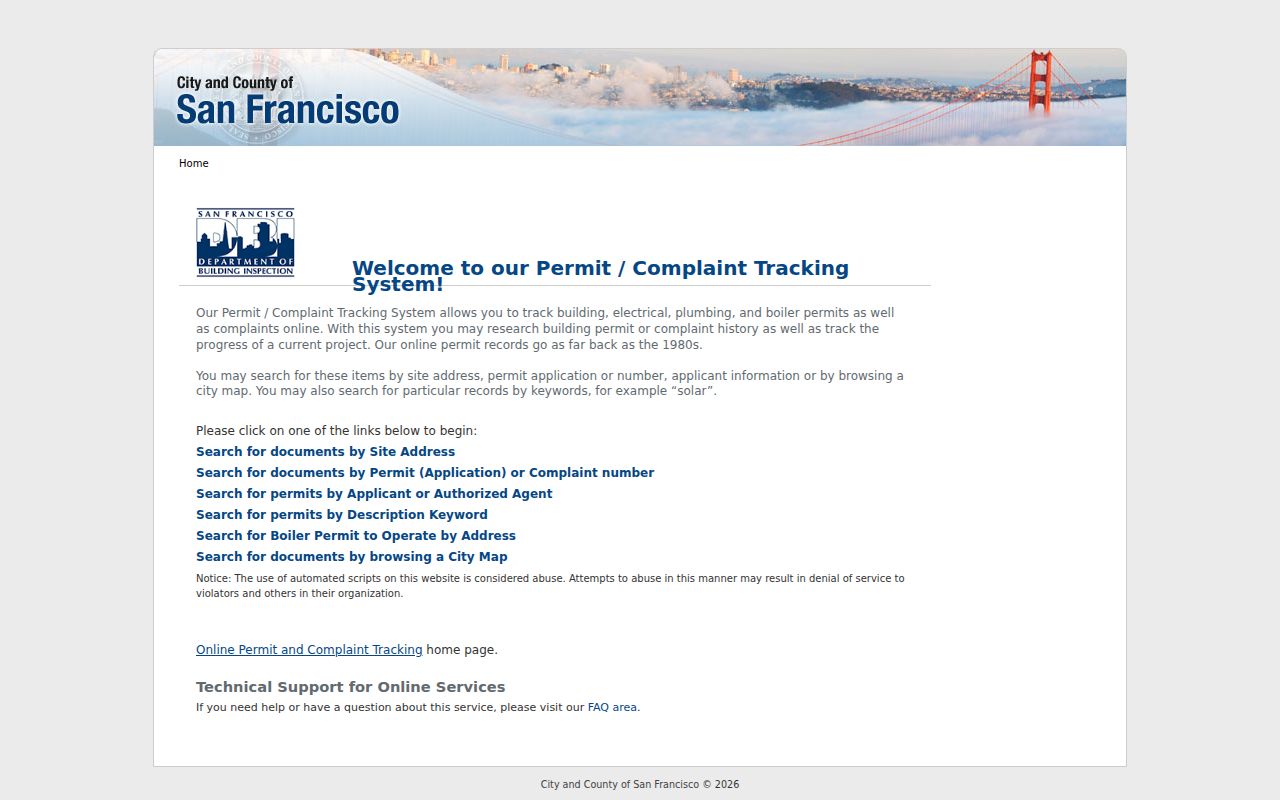
Permit results may identify applicants, agents, contractors, owner representatives, work descriptions, dates, and status. They can fill gaps when the public assessor view offers little ownership detail.
San Francisco Court Records Routes
San Francisco Superior Court offers a case-name or case-number query for unlimited and limited civil, family law, probate, and small claims matters filed from 1987 to the present. Calendar searches use case type and date, with calendars available up to 120 days ahead. Criminal cases have separate defendant, attorney, case-number, and cumulative-index paths. An index is a locator, not the complete court file.
The court's records access table lays out online, mail, in-person, and restricted routes.
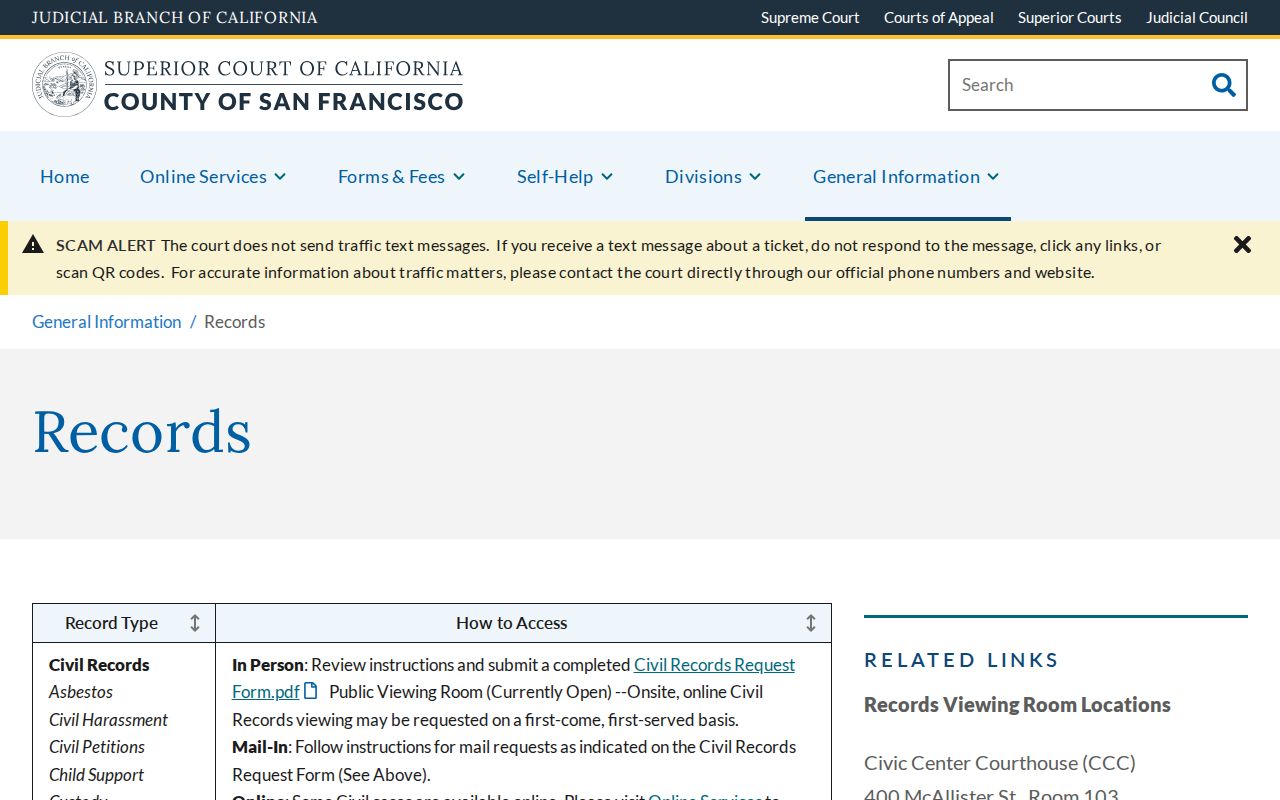
The distinction on that page matters. Full civil files may be reviewed at the Civic Center Courthouse public viewing room, while a criminal file request goes to Room 101 at the Hall of Justice in person or by mail. The court's case information page supplies the web queries.
Civil files are viewed in Room 103, and the clerk holds a valid photo ID during review. A file at least two years old may be off-site. Retrieval costs $6 and takes at least 15 business days. Mailed criminal requests need payment and a self-addressed stamped envelope. A Certificate of the Record costs $40 per court number.
Note: Confidential probate material needs advance approval for a non-party even when the case itself appears in an online index.
San Francisco Vital Records Copies
Birth, death, marriage, and divorce access depends on the event, its age, and the copy sought. The County Clerk and Department of Public Health handle local birth and death channels. Public marriage certificates route through the Assessor-Recorder, confidential marriage records through the County Clerk, and statewide forms through CDPH. A CDPH divorce certificate is only a certificate of record; the full dissolution file remains with Superior Court.
Under California Health and Safety Code section 103526, an eligible person may obtain an authorized certified copy after the required sworn statement or identity check. Others may request a certified informational copy marked as invalid for establishing identity. There is no open name-search portal for current certificates. Use the CDPH certificate forms or the correct local application, then submit the form, proof, and payment through its listed mail, online, or counter channel.
Copy eligibility matters. Paying a fee does not turn a restricted certificate into an authorized copy. Select the lawful copy type before ordering.
San Francisco Records Custodians
Three counters handle much of the local access work. The two City Hall offices have distinct duties, despite their shared address. The court clerk controls case files and its own copy rules.
Office of the Assessor-Recorder
City Hall, Room 190
1 Dr. Carlton B. Goodlett Place
San Francisco, CA 94102
Deeds, liens, maps, assessment, and recorded-document services
Office of the County Clerk
City Hall, Room 160
1 Dr. Carlton B. Goodlett Place
San Francisco, CA 94102
Certificate, marriage, FBN, notary, and registration services
Civil Records Division
400 McAllister Street, Room 103
San Francisco, CA 94102-4514
415-551-3802
Weekdays except court holidays, 8:30 a.m. to 4 p.m.; closed noon to 1 p.m.
The County Clerk covers fictitious business names, certificates, marriage services, domestic partnerships, notary oaths, and registrations. Assessor-Recorder holds deeds, liens, maps, and assessment functions. Civil clerks provide terminals, file viewing, copies, certified dissolutions, and warehouse retrieval, but no legal advice.
San Francisco Custody Record Search
Custody systems are divided by agency. The Sheriff's local jail lookup asks for the first three letters of both the first and last name. It covers current San Francisco jail custody, not the state prison system. California Department of Corrections and Rehabilitation custody belongs in CIRIS. Federal custody uses the federal locator, while older federal files may have moved to archives.
SFPD incident reports and body-worn-camera requests use the department's records request channel. Those files can be limited by investigatory exemptions, privacy rules, and redactions. California's offender registry is a separate statutory tool with legal-use warnings, not a general name directory.
Note: Search the agency that holds the person now; county jail, state prison, and federal custody databases do not share one result set.
San Francisco Records Fees
Fees attach to the copy or service, not merely to finding many indexes. Recorder viewing is free, DBI and property portal searches are free, and electronic CPRA production is often free. Certification, paper copies, stored-file retrieval, certificates, and special statutory services may cost more. Current San Francisco County Clerk charges include $31 for a birth search and certified copy, $26 for death, and $19 for a confidential marriage record search or certified copy.
The clerk's 2026 schedule also lists a $69 fictitious business name filing and indexing charge, plus $17 for each added name or registrant at the same location. An indexed official-record search is $14 per record type. Some service fees change on July 1, 2026, so use the current County Clerk fee schedule before sending payment.
Requesting San Francisco Public Records
The California Public Records Act, Government Code section 7920.000 and following, allows any person to request an identifiable agency record. An office need not do research, create a new file, or compile data it does not keep. It must determine within 10 days whether it has responsive, disclosable material. Unusual circumstances can support a written extension of up to 14 days. Direct duplication charges and authorized special programming costs may apply.
- Name the custodian. Send a deed request to Assessor-Recorder, a court file request to the court, and a permit request to its department.
- Check the dedicated channel. Use the office index, form, or counter first when one exists.
- Describe existing records. Give the record type, date range, address, block/lot, case, permit, or document number, and a subject name when relevant.
- Choose a format. Ask for inspection or an electronic copy when that meets the need, and state whether certification is required.
- Review the response. Narrow an overbroad request, pay lawful copy charges, or ask the agency to identify the basis for a withholding or redaction.
San Francisco's open-records request portal lets a requester search prior requests or make a new one. Department-specific forms remain the right path for court, police, sheriff, certificate, and recorder services. The Secretary of State's CPRA access FAQ explains the statewide timing and scope rules.
Lawful personal use. Open records can support family history, heir research, civic review, and scam checks. Never use a name, address, or file to stalk, harass, intimidate, or harm a person.
Closed San Francisco Records
An exemption may protect a whole record or part of it. Agencies can redact private details while releasing the rest. Common limits include sealed cases, juvenile and adoption files, confidential probate material, medical data, active investigations, DMV information, confidential voter data, and protected addresses.
- Index
- A finding aid that identifies a filing; it is not always the full document.
- Certified copy
- A copy authenticated by the custodian for an official purpose.
- Custodian
- The office responsible for keeping and producing the requested record.
- Exemption
- A legal basis to withhold or redact information that would otherwise answer a request.
California's Safe at Home program supplies a substitute mailing address to qualifying participants. Its protection can affect voter, service, court, and other address trails. Private-sector deletion rights do not erase an official government filing, but a statute or confidentiality program can restrict what the government shows.
San Francisco Portal Fallbacks
When a web search fails, follow the record's physical path. Pre-1990 recorder documents go to City Hall Room 190 or historical collections. Civil files go to the Room 103 viewing desk, with mail and warehouse retrieval as needed. Criminal files use Hall of Justice Room 101. Certificate orders require the application, fee, and any sworn statement or identity proof tied to the copy type.
Older directories, newspapers, probate indexes, and transferred city-county material may sit at the San Francisco Public Library or History Center. Federal records may move to the National Archives. A blank result can mean the year is outside coverage, the file is off-site, the name differs, or access is restricted. It does not prove no record exists.
Note: Call or write the named custodian before traveling when a file may be stored off-site or subject to advance approval.