
Finding People Through San Francisco Records
Begin with the kind of fact already in hand. A full name works well in the Assessor-Recorder Records Manager, the Superior Court party search, the County Clerk fictitious business name index, and state business or license tools. An address belongs first in the Property Information Map or Assessor Community Portal. A phone number can be checked against the SFGov employee directory when the person may work for the city, while an old address belongs in the public library's reverse directories.
One result rarely proves identity. San Francisco records should be compared by middle initial, date range, parcel, agency, business name, or related party. A deed-index entry may lead to a block and lot. That parcel can lead to permits, and a probate case can tie the same name to relatives. Official indexes provide the clearest source and date context.
- Search the strongest official index for the known name, address, phone, or business.
- Record the exact date, document number, case number, agency, or block and lot returned.
- Cross-check a second custodian, such as the court, recorder, assessor, or County Clerk.
- Use library directories, newspapers, and archives when the event predates the online cutover.
- Ask the custodian for a copy or make a focused records request when an index is not enough.
Note: California's My Voter Status tool is a private self-lookup, not a public name directory; regulated access is detailed under San Francisco voter records.
San Francisco People Records Offices
San Francisco is both a city and county. The Assessor-Recorder is the central keeper for recorded deeds, liens, maps, and assessment functions. The County Clerk handles fictitious business names, confidential marriage services, certificate channels, domestic partnerships, notary matters, and several registrations. Superior Court keeps its own case records, while the Department of Elections, Sheriff, Police Department, Planning Department, and Department of Building Inspection each control their own systems. The complete access and copy rules belong in the San Francisco public records system.
Office of the Assessor-Recorder
City Hall, Room 190
1 Dr. Carlton B. Goodlett Place
San Francisco, CA 94102
Office of the County Clerk
City Hall, Room 160
1 Dr. Carlton B. Goodlett Place
San Francisco, CA 94102
Superior Court Civil Records
400 McAllister Street, Room 103
San Francisco, CA 94102-4514
415-551-3802
San Francisco City-County Search Shortcut
The consolidated government removes one common jurisdiction puzzle. There is no separate incorporated city whose clerk competes with a county recorder for the same local geography. One Assessor-Recorder, County Clerk, Sheriff, Department of Elections, and Superior Court serve the county. The shortcut is geographic, not technical. Each office still has its own portal, rules, and copy channel.
Use the Index to Records of San Francisco when the right custodian is unclear. The inventory identifies departmental record series and retention information. It helps turn a broad question into a request that names the office, record type, date range, address, permit number, or case number. California agencies need not conduct general research or create a new record for a requester.
San Francisco records are available for lawful personal research and civic transparency. Never use a name or address record to stalk, harass, threaten, or harm anyone.
Searching San Francisco Records Manager
Records Manager is the best name-first property index because it searches parties to recorded instruments. A grantor transfers an interest; a grantee receives one. Hits may include deeds, deeds of trust, reconveyances, liens, easements, notices, affidavits, maps, restrictions, and other recorded papers. Search name variants, initials, trust names, former names, and business entities. The online collection covers 1990 to the present. Earlier official records require the free City Hall kiosks in Room 190 or historical books and microfilm.
| Search control | Best use | Format note |
|---|---|---|
| Document Type | Narrow deeds, liens, releases, affidavits, or other instruments | Optional category list |
| Grantor/Grantee Name | Find a person or entity named in a recorded document | Try name variants |
| Document Date Range | Limit a move, transfer, or life-event period | From and to dates |
| Document Number | Return a known recording | Exact number or range |
| Block Lot | Connect the index to a San Francisco parcel | Assessor parcel identifier |
An index is a finding aid, not always the official proof. The recorded-document copy instructions explain online purchase, in-person access, and the distinction between an ordinary online copy and a certified copy. The modern expansion placed millions of 1990-present documents within online preview and purchase reach, but it did not erase the pre-1990 office fallback.
San Francisco Property Search Chain
An address-first lookup should begin with the Property Information Map. It can turn a street address into a block and lot, assessor summary, neighborhood, census tract, planning applications, permits, complaints, appeals, zoning, historic-preservation data, and map layers. Then move to the Assessor Community Portal for assessment history and property characteristics, and to Records Manager for the recorded chain. Some owner details are limited online and may require an official copy or data channel.
The block and lot is San Francisco's key parcel identifier. It links otherwise separate Planning, assessor, permit, complaint, and recorder records. A situs address means the physical location. A mailing address is where property correspondence goes. A difference between the two can be useful, but it should be verified through the official source.
The Assessor-Recorder real-property search shows the address or APN-oriented entry point.
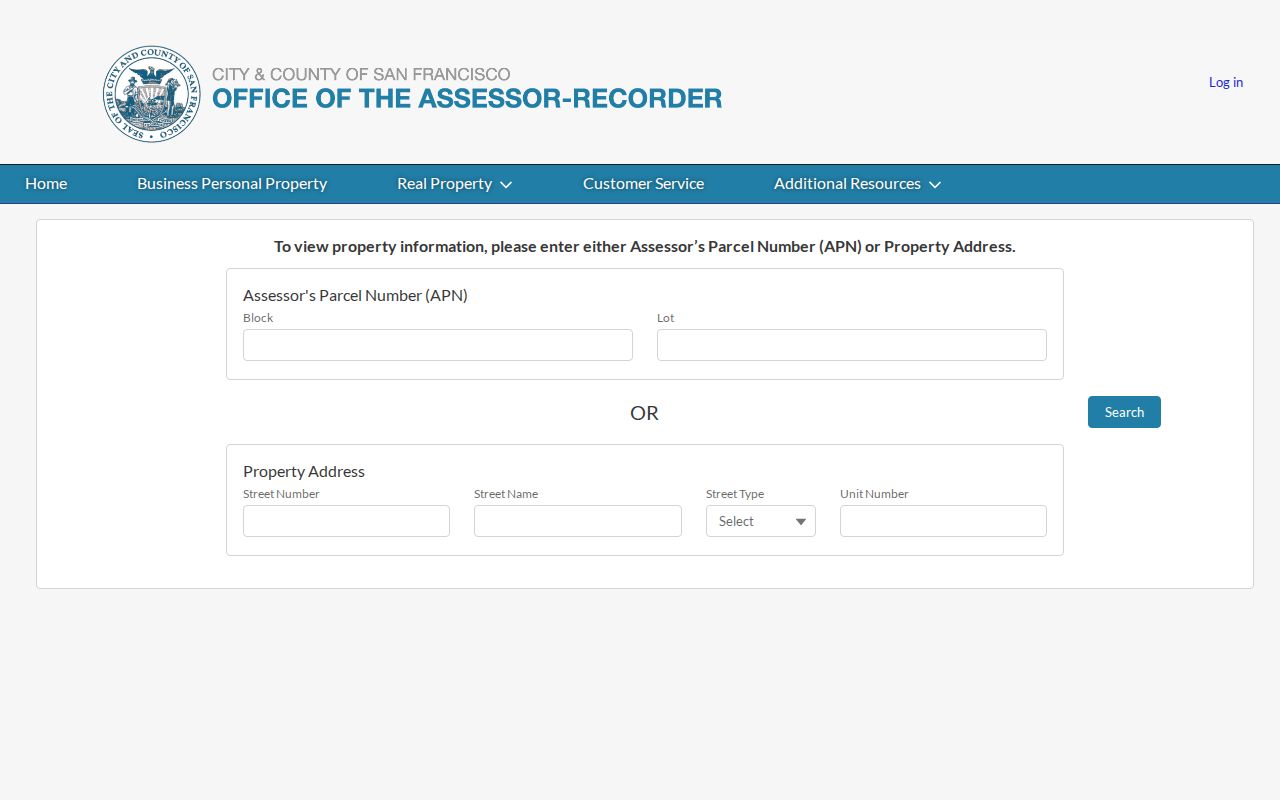
Its form illustrates why a known address or block and lot is more useful there than a broad owner-name query.
San Francisco Court Name Search
The San Francisco Superior Court case information page routes civil and criminal searches. Unlimited and limited civil, family, probate, and small claims queries cover cases filed from 1987 to the present and accept a case number or party name. Criminal information uses separate links. A docket is the court's chronological list of filings and events; it is not the same as the full file.
Full civil file review may require the public viewing room at 400 McAllister Street, Room 103. Older files may be stored off-site, with a $6 retrieval charge and at least 15 business days before notice. Criminal files use the Hall of Justice Records Department in Room 101 and may be requested in person or by mail. Sealed, juvenile, adoption, confidential, and in-use files follow separate limits.
| Court | Covers | Name Search | Access |
|---|---|---|---|
| SF Superior Court Civil Query | Civil, family, probate, small claims | Case number or party name | 1987-present index; clerk for files |
| SF Superior Court Criminal | Criminal cases | Separate query and cumulative index | Hall of Justice for full records |
| U.S. District Court, N.D. Cal. | Federal cases | PACER | Electronic, clerk, or NARA by age |
The court's source page displays the distinct case and calendar routes.
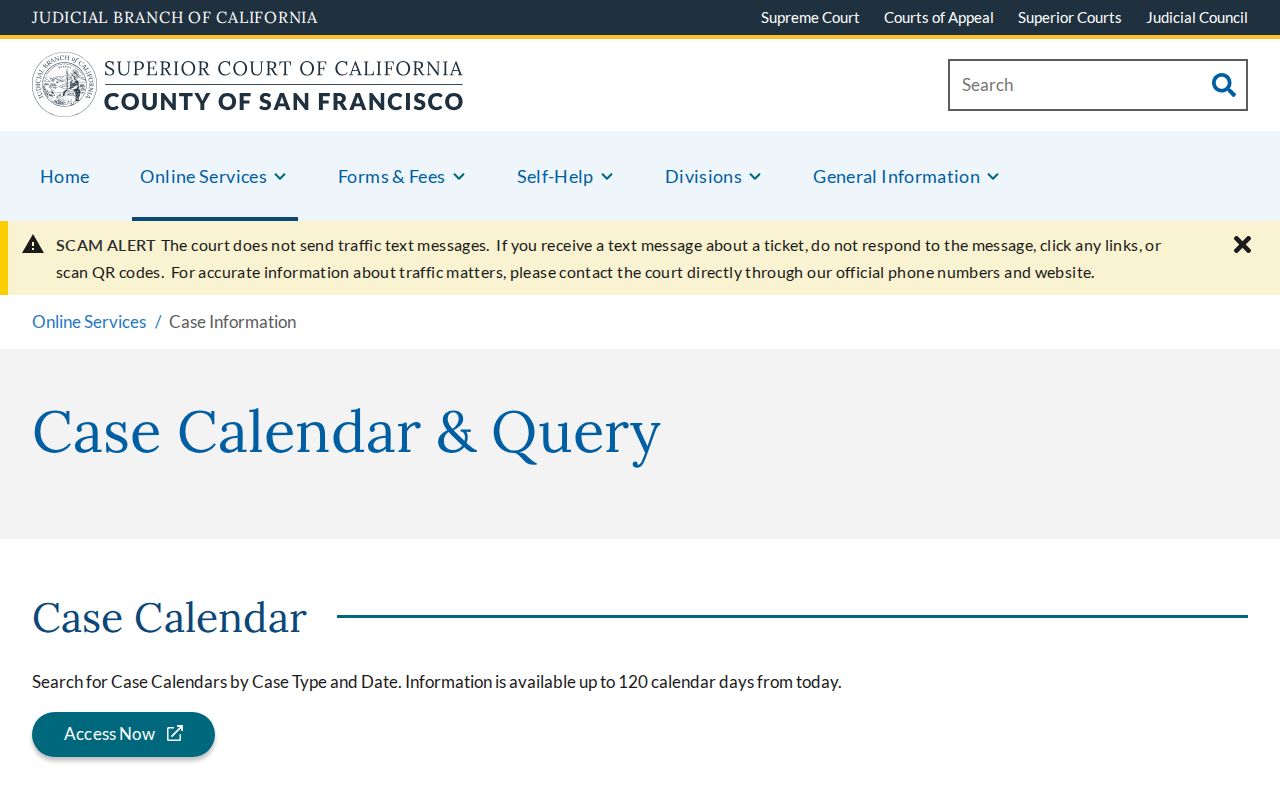
Use the case type and date coverage shown by the court before assuming an absent online result means no file exists.
San Francisco Vital Records Routes
Birth and death certificates move through San Francisco County Clerk or Department of Public Health channels based on the record and its age. The Assessor-Recorder handles public marriage certificates for licenses issued in San Francisco, while the County Clerk controls confidential marriage records and licensing services. CDPH-Vital Records supplies statewide forms for birth, death, marriage, and divorce certificates. A CDPH divorce certificate is not the full Superior Court dissolution file.
California Health and Safety Code section 103526 separates authorized certified copies from informational certified copies. Eligible applicants seeking an authorized copy must meet the relationship and sworn-statement rules. Others may receive an informational copy marked as invalid for identity purposes. Current listed fees are $31 for birth, $26 for death, $19 for marriage, and $18 for a state divorce certificate. Historical indexes, newspapers, and library databases may answer a genealogy question without ordering a certificate.
- Certified copy
- An official copy issued by the custodian under the applicable eligibility rules.
- Informational copy
- A certified record carrying the event information but marked as invalid for identity use.
- Decedent
- The person who died and is named in a death or probate record.
San Francisco Business Name Searches
A person tied to a trade name may appear in several official systems. The County Clerk FBN index accepts a fictitious business name, file number, registrant, corporation or LLC name, filing date, or confirmation number. FBN statements expire after five years, so renewals and abandonments matter. DataSF's registered-business dataset adds ownership name, DBA, street address, location dates, and closure status, with daily updates.
State tools extend the search. California SOS Bizfile covers corporations, LLCs, limited partnerships, agents, status, and filings. UCC search accepts a debtor, secured party, or file number. The Department of Consumer Affairs and board-specific lookups can verify license status and discipline. The SFGov employee telephone directory is different: it lists a current city employee's name, agency, and office phone, not private contact details.
The SFGov employee listing offers agency, name, and phone paths.
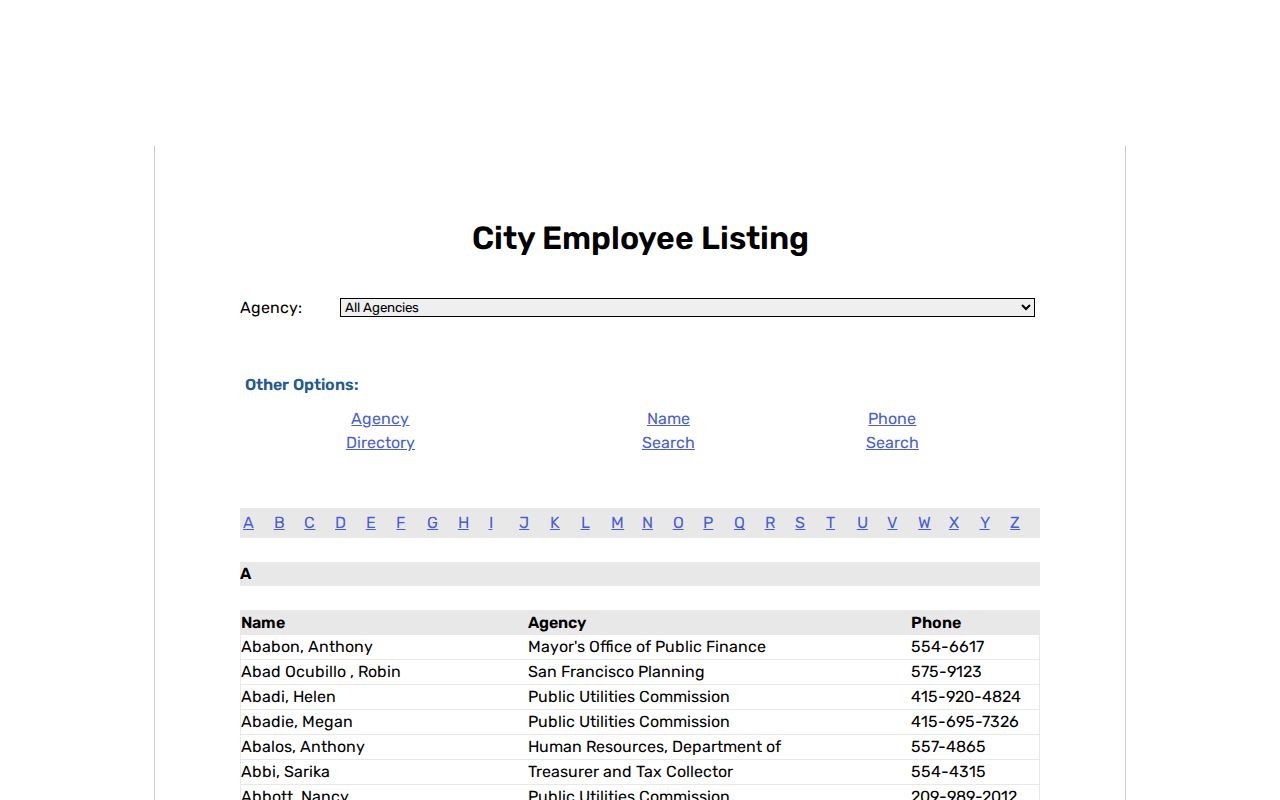
Its public entries confirm an agency connection and office number without exposing a home address or private personnel file.
San Francisco Custody Record Lookups
The Sheriff's Find a Person in Jail tool searches current local custody by entering the first three letters of both the first and last name. It does not cover state prison custody. California Department of Corrections and Rehabilitation CIRIS is the separate state search, while federal custody has its own locator. These systems answer different status questions and should not be treated as one statewide roster.
The California DOJ Megan's Law registry is another distinct tool with statutory use warnings. Police incident files are not obtained through the jail search. SFPD routes requests for incident-related documents, body-worn camera material, and some official data through its public-records channel, subject to privacy, investigative, and redaction rules.
Note: A custody match reflects the scope and update status of that specific system; verify the person and status with the responsible agency.
Historic San Francisco Directory Search
Older residents often appear in the San Francisco Public Library's holdings when modern portals stop. The library lists city directories from 1850 to 1960 on microform, 1875 to 1982 in print, and 1850 to 1982 online. Reverse directories run from 1953 to the current period in print. Phone books cover 1899 to 1992 on microform and 1921 to the current period in print. A reverse directory begins with an address and identifies an occupant or business.
The San Francisco History Center at the Main Library is also the archives for the City and County. It holds newspapers, maps, photos, manuscript collections, ephemera, and official archival material. The 1906 earthquake and fire makes those cross-sources vital. A missing local record may call for reconstructed evidence, newspapers, directories, probate, church registers, insurance records, or later filings rather than a dead end.
Newspaper and census work becomes stronger when paired with the directory shelf. Obituaries, marriage announcements, probate notices, business notices, and neighborhood reports can connect a listing to relatives or a later address. The 1950 federal census is open, but later population schedules are not. Enumeration-district maps, Sanborn maps, block and lot references, and reverse directories help stabilize an address before searching census pages. Researchers should also allow for changed surnames, initials, Spanish compound names, and different Chinese romanization forms across Mission, Chinatown, North Beach, South of Market, Richmond, Sunset, Bayview, and other neighborhood sources.
NARA San Francisco adds federal court, immigration, maritime, military, Angel Island, and Chinese Exclusion Act records. Those federal holdings can be central to Bay Area family research, not just a distant archive layer.
San Francisco Heir Search Trail
An heir search works best by joining probate, death, newspaper, and property records. Start with the Superior Court probate query for the decedent's estate. The docket can identify the case and filings, while accessible documents may name fiduciaries, creditors, addresses, or heirs. Some confidential probate material needs advance approval, and non-parties do not receive automatic access to every document.
Next, use obituary and newspaper sources at SFPL, an informational death certificate where permitted, and recorded affidavits or deeds in Records Manager. A transfer from an estate or trust may identify a successor representative or parcel. Historical directories can place the family at an address before the death. This sequence is a strong personal-use trail because each step has a named custodian and date context.
Requesting Missing San Francisco Records
Use a dedicated portal first. When it does not hold the needed file, the California Public Records Act, Cal. Gov. Code section 7920.000 et seq., provides a request path for identifiable state and local agency records. San Francisco's NextRequest portal lets the public search prior requests and submit a new one across many departments. Courts, police, sheriff, Assessor-Recorder, and County Clerk also maintain specialized channels.
A useful request names the department, record series, dates, address, permit, parcel, case, or desired electronic format. Agencies determine within 10 days whether responsive records are disclosable. Unusual circumstances may support a written 14-day extension. Exempt data can be withheld or redacted, and agencies need not create a record or research a question.
The San Francisco request portal visibly separates searching past requests from making a request.
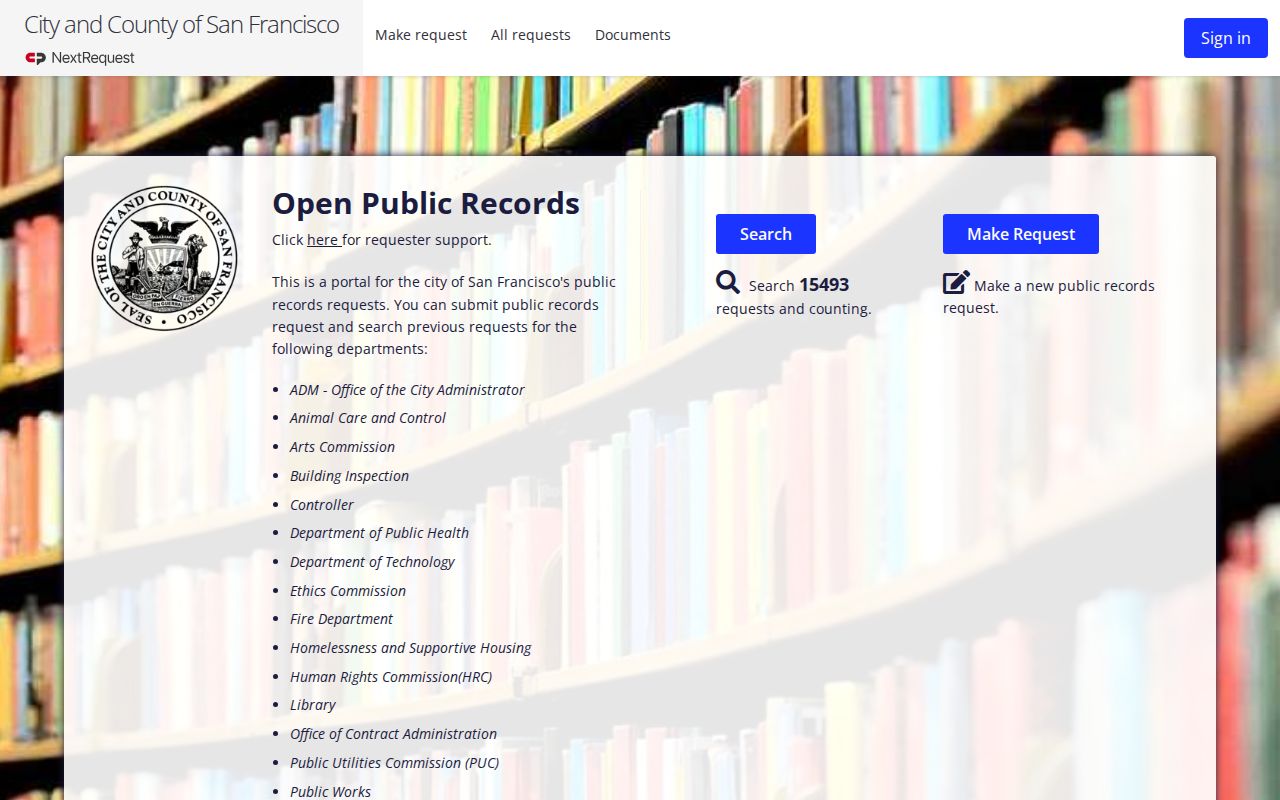
Reviewing prior requests can reveal a department or record description that makes a new submission more precise.
San Francisco Search Privacy Lines
Not every official record is open browsing. Sealed court matters, juvenile and adoption files, confidential probate or family documents, protected voter details, DMV data, and some investigatory or medical information may be withheld. California vital records limit authorized certified copies, and voter-file access is purpose-limited. Safe at Home provides a substitute mailing address for qualifying survivors and other protected participants.
Official records also differ from commercial compiled results. An official index usually states the custodian, coverage, filing date, and copy path. A compiled result may be fast but stale, mixed, or unsourced. Compare names and dates, never assume a shared name proves identity, and use only lawful personal, genealogy, estate, consumer-safety, or civic purposes.
| Source type | Strength | Key limit |
|---|---|---|
| Official portal | Known custodian and record scope | May show an index rather than a full file |
| Counter or mail request | Copy and certification options | Fees, eligibility, and wait times may apply |
| Library or archive | Deep historical context | Some sources require on-site or licensed access |
| Commercial compilation | Broad preliminary matching | Can be stale, merged, or unsourced |